
An Archive
An exploration of experiences that are minimized, archived, forgotten.

I began my own journey with medical transition while a student at Berkeley. For years I had known I was nonbinary, publicly identifying as such, but struggled to claim the word transgender. It seemed like something more than I was — like something I had to earn.
In the UK, NHS gender identity clinics had a pattern of denying nonbinary individuals the same treatment offered to their binary trans counterparts. I first thought that I was overreacting when I worried at hearing stories of nonbinary people being denied hormone treatment, but would later learn the same issue exists in the US, though it is not as reported.
My misplaced feelings of inadequacy would thus go on to represent my experience in seeking healthcare. Ahead of my first appointment, I was advised by friends not to say I was nonbinary, but rather to posture as a trans woman so as to be taken more seriously.
Overall, my experiences accessing healthcare were smooth. After an initial appointment, I felt more comfortable owning my identity, and have been transitioning medically for nearly four years.
This same affordance of care is not, however, standard.
Across the US and the broader landscape, trans rights are quickly eroding. On the same day he was sworn in for a second term as president, Donald Trump signed an executive order declaring the US would only recognize two genders, those assigned, ironically, “at conception.”
Amidst this fast-changing landscape, I applied, and was accepted to, a residency at In Cahoots. I was interested in continuing the train of thought I had begun during my chapbook Fragments of Spring, where I thought about the process of transition from an internal, rather than external or medical, perspective.
The chapbook form I used prior also felt a poor fit. Instead, I wanted to explore a physical form that would mirror the content within such that the reader would feel as though they were taking part in the archiving, or boxing up, trans thought.
As so much was being done to erode the rights of trans people to, if they so desire, undergo medical transition, I wanted to shift my focus towards healthcare. Where my chapbook was a celebration of transition, this would be an archive of barriers.
Over the course of six months I asked trans folks in North America to share with me just one question posed to them by a medical provider who determined the care they would receive.
I spoke with friends and acquaintances about their early experiences, distributed an anonymous survey in local and online communities, and I asked friends to help me identify others in their networks who were willing to share.
These questions I synthesized into eight questions representative of the overall content and tone of what had been shared.
These questions, though a portrait of care in the 2020s, were still detached from the larger historical trajectory of trans healthcare: I wanted to capture the shift in how care is accessed that has occured in recent years. To accomplish this, I read through diagnostic manuals from the 1980s and 90s, similarly adapting five of these questions to be included in sequence with their contemporary counterparts.
Once my questions were assembled, I was most moved by the difference in tone that I saw: the decades old diagnostic questions used dated language, and were occasionally outright offensive, but did not seem radically out of step with the contemporary responses. Both sets of questions did not seem overly concerned with the inner lives of the individual, but rather their familial, sexual, and aesthetic roles in their communities.
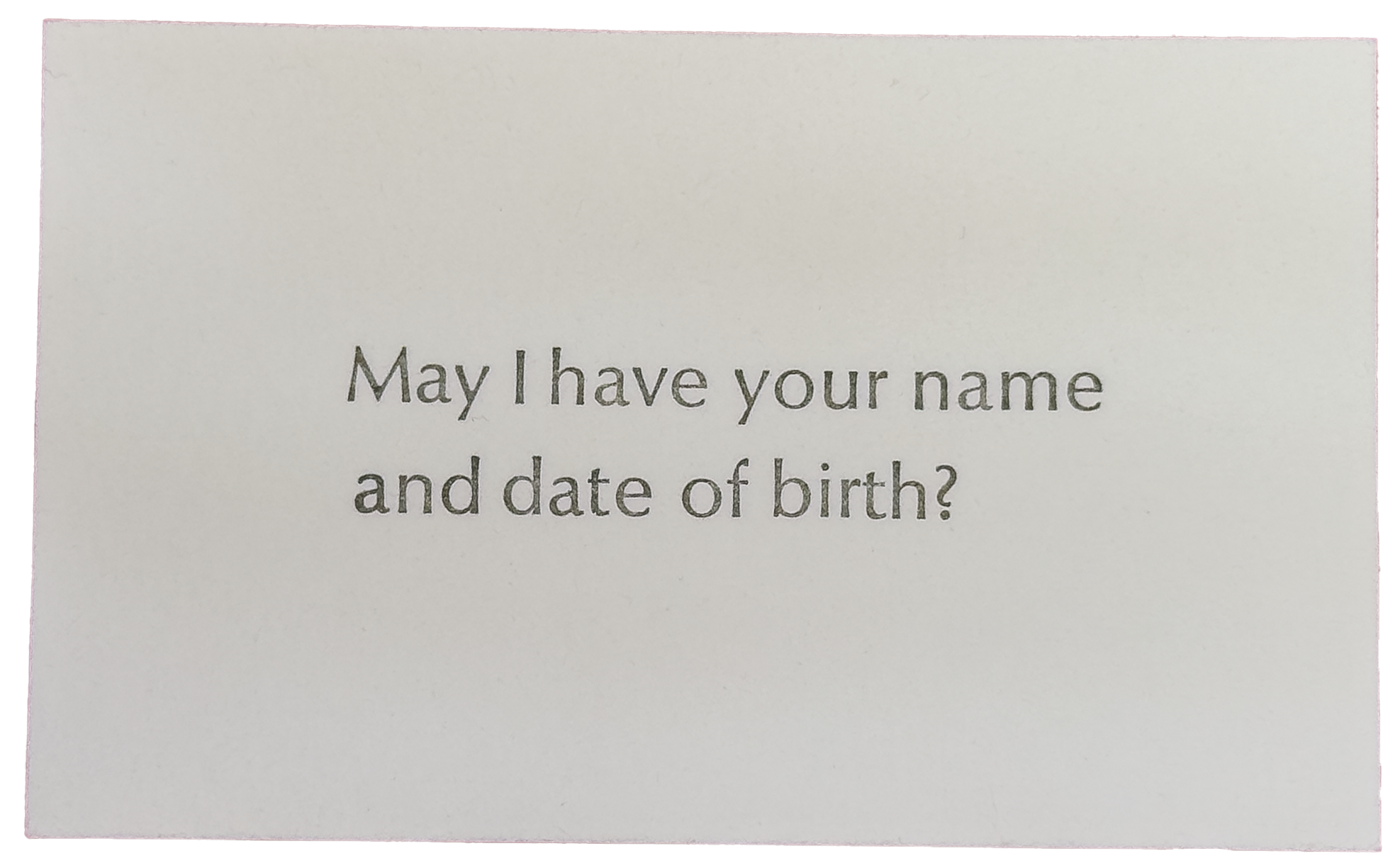
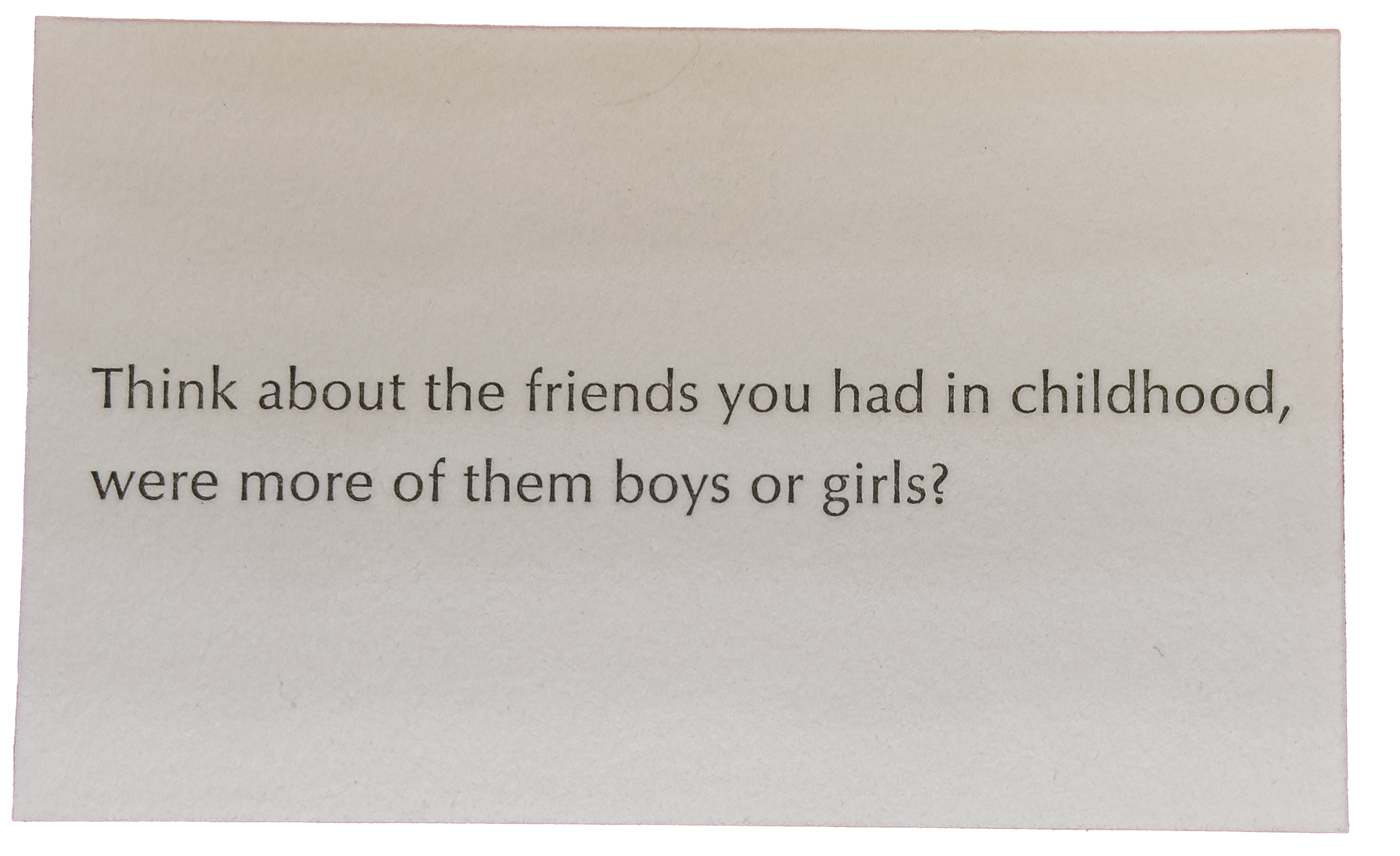
One card, pulling from a diagnostic manual, asks “What sort of toys did you play with as a child?” while a contemporary question asks “were more of [your childhood friends] boys or girls?”
Both attempt to ask the same question — whether the patient has a temporal basis to their claim that they are not the gender they were assigned at birth — adjusting the aesthetics, rather than the content, of their question.
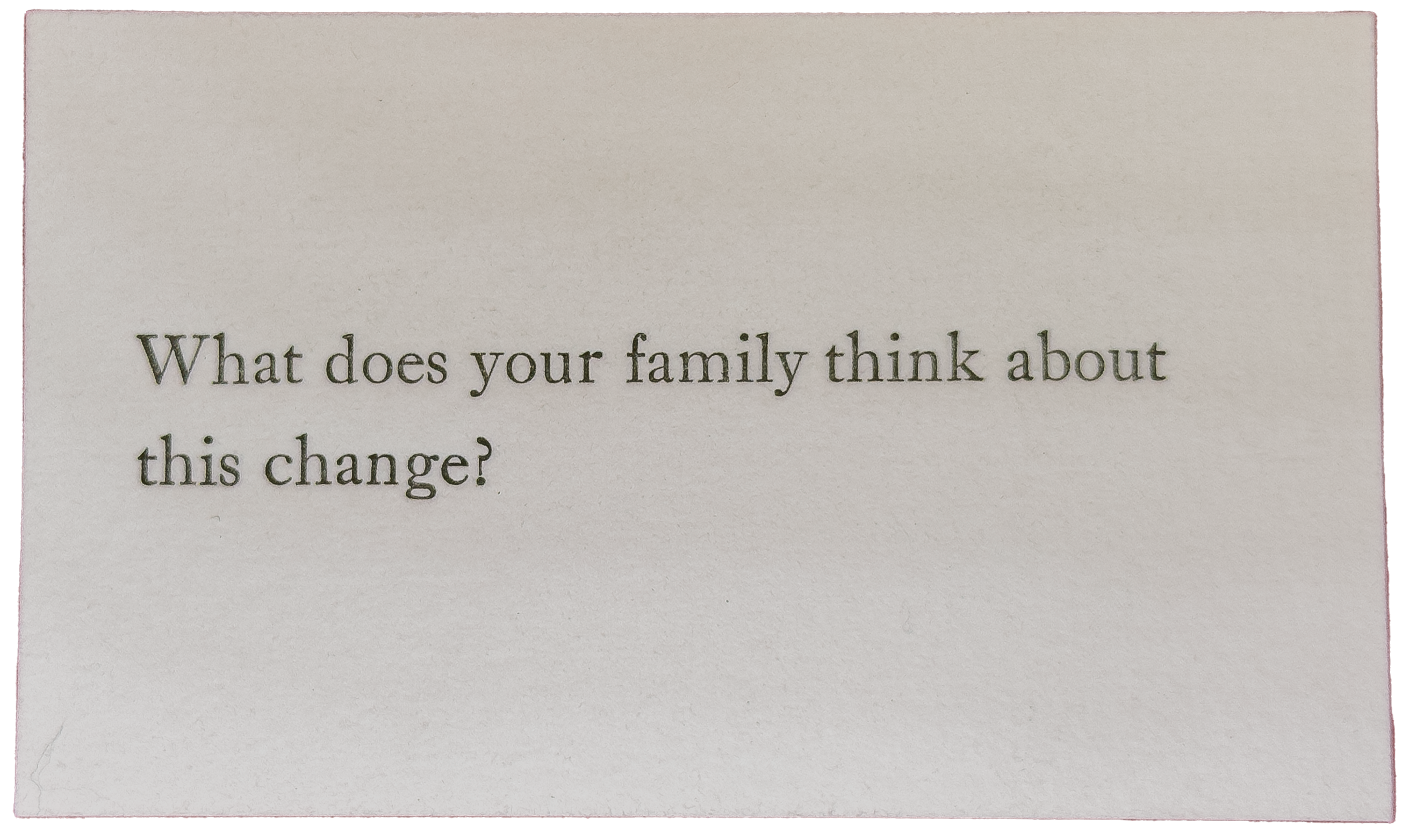
When I arrived at In Cahoots, I spent my first days handsetting the questions and colophon in lead type, which I then printed on a range of archival papers. I wanted each question to feel personal, and for each piece in the edition feel slightly different, such that the questions could feel unique.
Most of my time at the residency was spent cutting out cards and assembling boxes. For four days I remained in the bindery, measuring, cutting, gluing from 7 in the morning till 11 at night. Frequently my only break for the day was a quick lunch while I thought out my next steps.
I had chosen to use nonarchival chipboard for the boxes, so that the experiences of trans people would outlive the container used to house them. Unfortunately, this meant the chipboard was not square, and I had to measure and trim each piece to ensure the finished pieces would not be lopsided.
Before coming, I had completed several dummies. However, because this was my first project integrating boxmaking, my pace was slow, and those days in the bindery dragged, the piles of cards and questions acting as poor company.
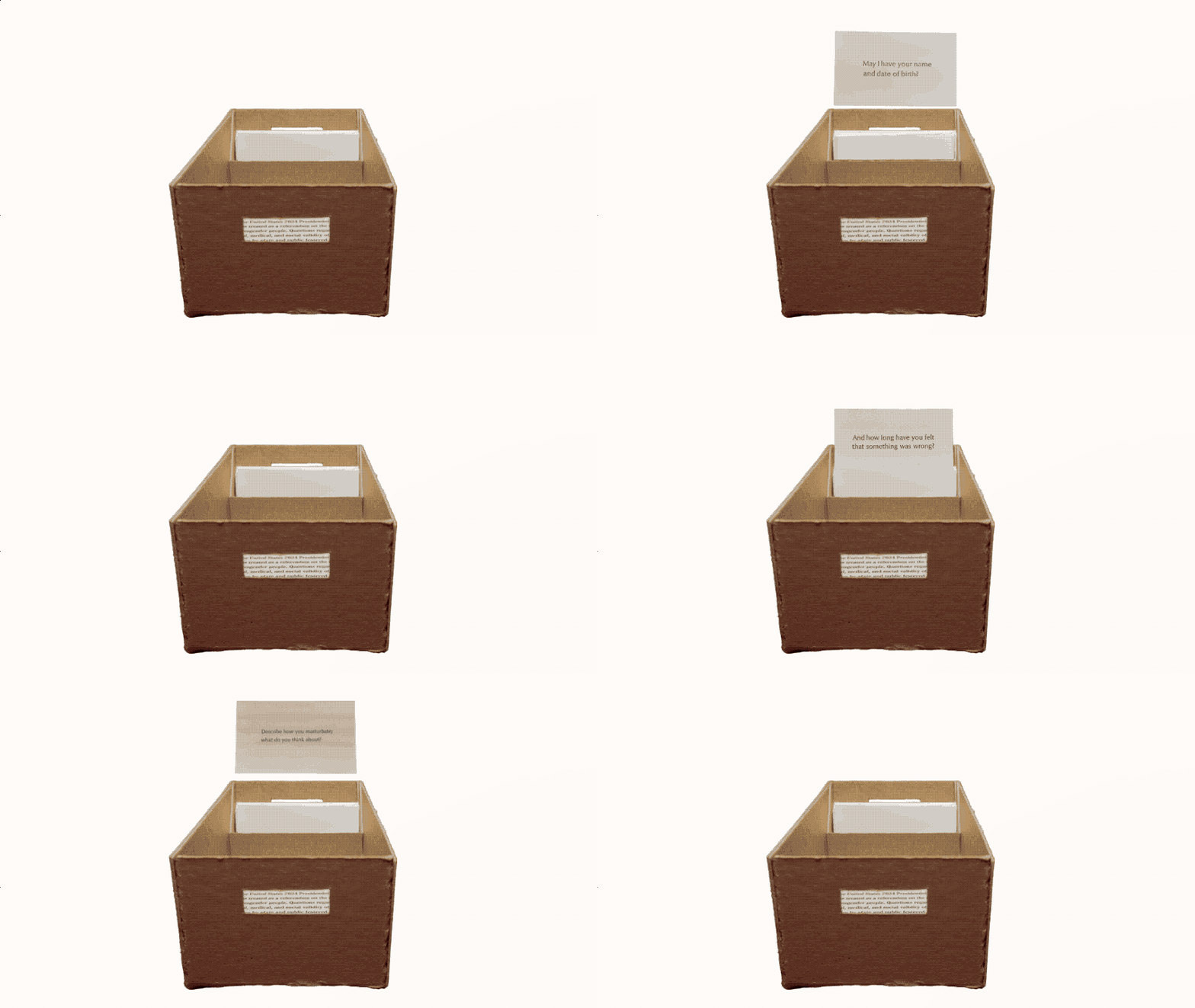
The finished edition of 15 is separated into three parts: the box and lid evoking a bankers box; a colophon, dominating three quarters of the box’s length, and the thirteen cards which are separated by partition, and may be handled in any order.
In the first few months of publication, copies of An Archive were acquired by the Bowes Arts & Architecture Library, Bancroft Library, and UCLA’s Arts library. I am excited at the prospect of going to see it in the future once the box’s degredation has begun while the cards inside it remain.
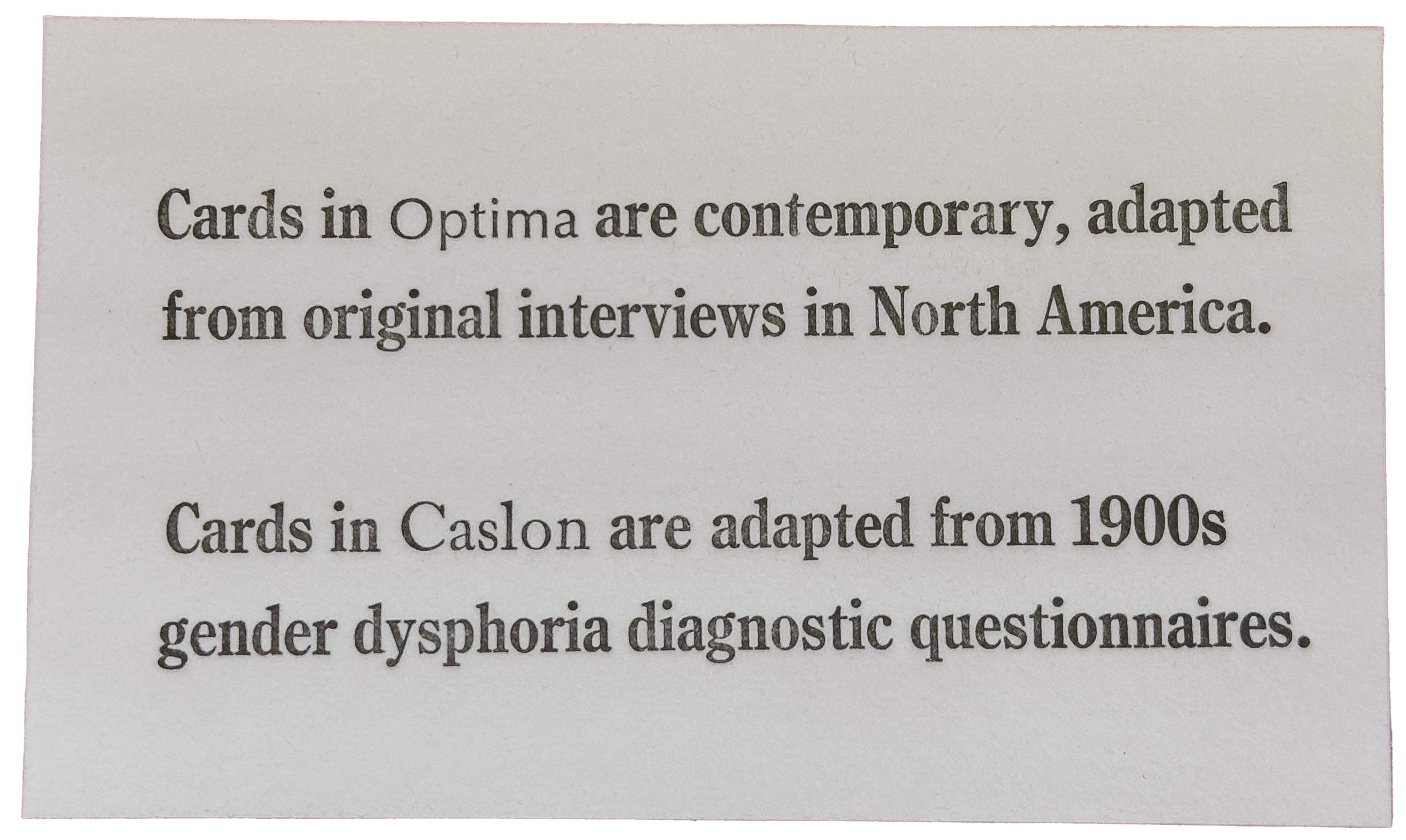
When writing the colophon, I opted to affect the same tone as the object itself: cold and bureaucratic. In the same way the boxes are imperfect, so too I wanted the colophon to feel disconnected in some way.
First, I wrote several versions exclaiming the horror I felt at the present situation or my perspective on the questions inside. The finished version instead reads as a retrospective on the era we are currently living through. I stripped almost all words that could be viewed as anything but ‘neutral’ on the validity of trans lives, allowing myself one charged verb, "festered” to describe the changed landscape.
The colophon is typeset in Century Oldstyle, the same family used by the Supreme Court to write its opinions. It thus becomes itself a relic, dated and aging along with the box is it glued into; they will meet the same eventual degradation of both material and meaning.
It reads, in full:
The United States 2024 Presidential election was treated as a referendum on the rights of transgender people. Questions regarding the legal, medical, and social validity of trans bodies by state and public festered.
An Archive pulls from intake questions asked when seeking gender affirming care. Printed on spare archival papers with handset Caslon, Century Oldstyle, and Optima in 2026 during a residency at In Cahoots by Autumn de Leon.1
Of 15 copies, you hold number...
Lavender Corazon1 Press
1In Cahoots did not have Spanish accents available; written properly, León, Corazón.